

Last Updated: October 28, 2026
Quick Summary
To make floral ice cubes, place small, food-safe flowers in a silicone tray, cover them with cooled filtered water, and freeze in stages so the petals stay suspended. Choose mild edible blooms such as pansies, mini rose petals, or cornflowers, and confirm each species is edible before using it.
- Use only food-grade or culinary-grown flowers, identified by their botanical name.
- Freeze in stages so each layer sets before the next flower goes in.
- Pansies, mini rose petals, and cornflowers suit light cocktails like gin and tonics.
- Store floral ice cubes in a labeled, sealed container and use them within one to two months.
Table of Contents
- What You Need to Make Floral Ice Cubes
- Choosing the Best Edible Flowers for Cocktails
- Preparing and Placing Flowers in the Tray
- Freezing Floral Ice Cubes in Stages
- How to Make Clear Ice Cubes with Flowers Inside
- How Long to Freeze Floral Ice Cubes
- Troubleshooting Cloudy Cubes and Floating Petals
- How to Store Floral Ice Cubes Before Serving
- Pairing Floral Ice Cubes with Your Next Cocktail
- Frequently Asked Questions
What You Need to Make Floral Ice Cubes
Making floral ice cubes at home takes very little equipment, and most of it is probably already in your kitchen. You will need a silicone ice cube tray or mold, filtered water, a few food-safe flowers, a small spoon or dropper, and a clean towel for drying petals. Freshly Preserved offers freeze-dried edible flowers.
A clear, shallow tray is ideal. Larger cubes melt more slowly in a drink, so a standard two-inch cube mold is a good starting point. Keep your freezer level and clear of strong odors, since ice can pick up flavors from nearby food.
Quick tip: Set your tray on a flat shelf before you start. A level tray keeps the flowers from drifting to one side.
Choosing the Best Edible Flowers for Cocktails
Not every flower belongs in a drink. You can shop our cocktails and beverages collection for flowers already chosen for drinks. Choose blooms that are small enough to fit inside a cube and mild enough to complement the spirit or mixer. If you want a petite flower sized for drinks, freeze-dried miniature pansies are made for this purpose. The flowers below are commonly used in culinary settings.
| Flower | Size | Best For | Flavor Notes | Why It Works |
|---|---|---|---|---|
| Mini rose petals | Small | Gin, champagne, and prosecco drinks | Light, floral, faintly sweet | The petal's soft aroma mirrors the botanical notes in gin and the acidity of sparkling wine without overpowering either. |
| Pansies | Small to medium | Spritzers, lemonade, and vodka sodas | Mild, slightly sweet, almost grassy | Pansies are nearly flavorless, so they add color to light, citrus-forward drinks without changing the taste. |
| Bachelor's buttons (cornflowers) | Small | Gin and tonics, dry martinis | Crisp, clean, faintly spicy | The blue petals stay vivid in clear spirits and echo the juniper and citrus in a G&T. |
| Orchids | Small | Champagne, lychee martinis, tropical drinks | Delicate, slightly sweet | Orchid petals are sturdy enough to hold their shape through a slow melt and suit fruity, aromatic cocktails. |
| Mini carnations | Small | Whiskey sours, sangria, party punches | Mild, clove-like | The warm, spicy note stands up to darker spirits and red wine mixers where delicate flowers would disappear. |
| Mixed petals | Varied | Party punches and large-format cubes | Colorful, versatile | A mix gives visual variety in a punch bowl where individual blooms would be lost. |
How to Verify a Flower Is Safe to Eat
Before any flower goes into a cube, confirm three things: the species is edible, the flower was grown for culinary use, and it has not been treated with pesticides or preservatives.
- Confirm the species. Use the botanical (Latin) name, not the common name, because common names overlap. For example, "marigold" can refer to edible Tagetes tenuifolia or to ornamental Calendula varieties sold only for display. Check a reputable culinary or extension-service source before using any flower for the first time.
- Buy food-grade or grow your own. Flowers sold for culinary use are grown and handled under food-safety practices. Florist blooms and garden-center plants are usually grown for appearance, not consumption, and may carry pesticide residues, floral preservatives, or surface contamination.
- Avoid flowers from roadsides, parks, or unknown gardens. These can be exposed to exhaust, herbicides, and animal waste.
- Skip any flower you cannot identify with certainty. When in doubt, leave it out.
A short list of flowers commonly cited as edible includes pansies, violas, nasturtiums, calendula, cornflowers, roses, orchids, carnations, and chive blossoms. Some popular garden flowers, including oleander, foxglove, lily of the valley, and hydrangea, are not edible and should never be used. This is not a complete list; verify each species individually.
Petals vs. Whole Blooms
Whole blooms look best when the flower is small enough to sit inside the cube without crowding it.
Allergy and Dietary Considerations
Quick tip: Keep a small notebook or phone note listing the botanical name, source, and purchase date of each flower you use. It makes repeat batches faster and gives you a record if a guest asks what is in the glass.
Preparing and Placing Flowers in the Tray
Freeze-dried flowers need less prep than fresh ones, but a quick check still helps. Gently pat each petal dry and remove any dust or broken bits. A small pair of tweezers makes placement much easier.
Next, plan your layout before the water goes in. Put one or two blooms in each compartment, leaving room for the water to cover them completely. Too many petals in one cube can make it cloudy and crowded.
Positioning Flowers Face Down or Centered
Placement changes how the flower looks once the cube is set. Place pansies and roses face down so the best side shows when you look through the bottom of the ice. Center smaller flowers in the middle of each compartment so they float evenly and look balanced.
Freezing Floral Ice Cubes in Stages
Watch out:
Figure: a simple flowchart of the staged freezing steps, with each stage labeled.
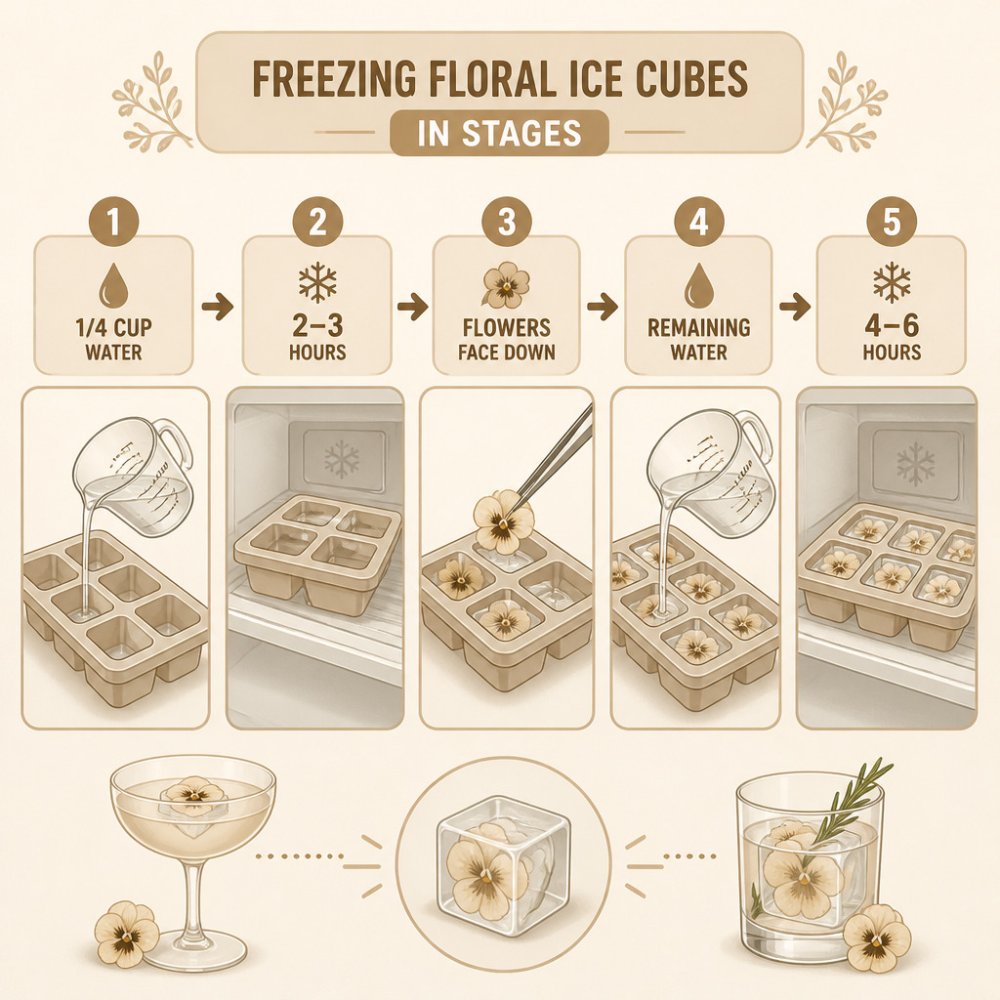
How to Make Clear Ice Cubes with Flowers Inside
For more methods and tips on making flower ice cubes, see our DIY Edible Flower Ice Cubes guide.
How Long to Freeze Floral Ice Cubes
Do not rush the process by setting the freezer to its coldest setting. Extreme cold can crack silicone trays and make the ice cloudier.
Troubleshooting Cloudy Cubes and Floating Petals
Even careful makers run into problems. Here are the most common fixes.
- Cloudy cubes: Use boiled, cooled filtered water and freeze slowly.
- Floating petals: Use the staged method and let each layer set before adding flowers.
- Flowers stuck to the tray: Rinse the tray lightly with water before adding petals.
- Petals turning brown: Keep cubes in the freezer and avoid repeated thawing.
- Tray cracking: Use a flexible silicone mold and avoid overfilling.
How to Store Floral Ice Cubes Before Serving
Floral ice cubes are best used within a few weeks, but a little care keeps them clear and colorful far longer. The enemies are freezer burn, odor transfer, and repeated thawing.
The Right Container
Separate layers with parchment or wax paper if you are stacking cubes in one container. This prevents them from freezing together into a block.
Label and Date
Label every container with the date and the flowers used. As a practical guide, plan to use floral ice cubes within about one to two months for the best appearance. They remain safe to use longer, but the petals may fade and the ice may pick up freezer odors over time.
Preventing Odor Transfer
Ice absorbs odors easily, and a bag of onions or a tray of fish can change the taste of a delicate gin and tonic. Store floral cubes in a dedicated area of the freezer, away from strong-smelling foods, or place the container inside a larger sealed bin. Activated charcoal or a small open box of baking soda in the freezer can help absorb ambient odors.
Make-Ahead Timeline
For a party, work backward from serving time:
- Two to three days ahead: Freeze the cubes in stages and transfer them to storage containers once solid.
- The day before: Check the cubes for clarity and discard any that cracked or clouded badly.
- The day of: Move cubes to a cooler only if you are transporting them, and pack them with a cold pack or dry ice so they stay solid.
What Not to Do
- Do not refreeze thawed cubes. Once a cube has melted, refreezing it produces cloudy, misshapen ice and softens the petals.
- Do not store cubes loose in the freezer. They will absorb odors and stick to shelves.
- Do not stack heavy items on top of the container. Pressure cracks the cubes and clouds the ice.
Watch out:
Pairing Floral Ice Cubes with Your Next Cocktail
Browse the Ultimate Guide to Edible Flower Cocktail Garnishes for more pairing ideas, or see our best edible flowers for cocktails guide to find the right bloom for your drink.
Frequently Asked Questions
How do you make floral ice cubes for cocktails?
Rinse edible flowers gently and pat them dry. Fill each compartment of an ice cube tray with a small amount of filtered water and freeze until just set. Place one flower face down on the frozen layer, centering it, then top with more water and freeze until solid. Use a freeze-dried edible flower such as Freshly Preserved's Freeze-Dried Edible Flower Petals ($24.99) or Freeze-Dried Edible Flowers Pansies & Orchids ($39.99).
Which flowers are safe to put in cocktail ice cubes?
Only use flowers sold as food-grade edible flowers. Pansies, orchids, mini roses, bachelor buttons, and carnations are common choices. Avoid any flower you cannot confirm is edible.
How long can you keep floral ice cubes before serving?
Freshly Preserved's freeze-dried edible flowers have a shelf life of over 1 year when stored in a cool, dry place.
Ready to make your first batch? Freshly Preserved offers freeze-dried edible flowers in bulk for home makers and professionals alike. Visit our bulk orders page to plan a larger order for events or shop our flower collections for everyday use.


