

Table of Contents
- Why Edible Flowers Belong on Wedding Cakes
- Quick Comparison: Top Edible Flowers for Wedding Cakes
- 1. Freeze-Dried Edible Peonies
- 2. Freeze-Dried Edible Pansies
- 3. Freeze-Dried Edible Begonias
- 4. Freeze-Dried Edible Mums, Cosmos, and Dahlias
- 5. Freeze-Dried Edible Basil Flowers
- 6. Seasonal Cake Decorating Kits
- How to Clean Edible Flowers for Cakes
- Edible Flower Cake Decorating Ideas
- How to Store Edible Flowers
- Sugar Flowers vs. Fresh Edible Flowers
- Sourcing Food-Grade Flowers Safely
- Allergy Considerations for Edible Flowers
- Pairing Flowers with Cake Flavors
- Frequently Asked Questions
Last Updated: September 16, 2026
Why Edible Flowers Belong on Wedding Cakes
The best edible flowers for wedding cakes are food-grade, pesticide-free blooms that hold their shape and color through transport and display, and freeze-dried varieties now lead that category for one practical reason: they arrive ready to place. This guide from Freshly Preserved covers the varieties that work, how to prepare them safely, and how to pair them with cake flavors.
Fresh blooms wilt within hours of leaving the cooler. That single fact reshapes how couples and planners should think about floral cake design. A sugar flower lasts indefinitely but tastes like nothing. A fresh petal looks perfect at 2 p.m. and tired by the reception toast.
Freeze-dried edible flowers solve the timing problem. They keep their original shape, color, and flavor without refrigeration, and they can be placed hours before guests arrive.

Below, we break down the best edible flowers for wedding cakes by variety, color, and use case, plus the cleaning, storage, and allergy considerations most guides skip.
Quick Comparison: Top Edible Flowers for Wedding Cakes
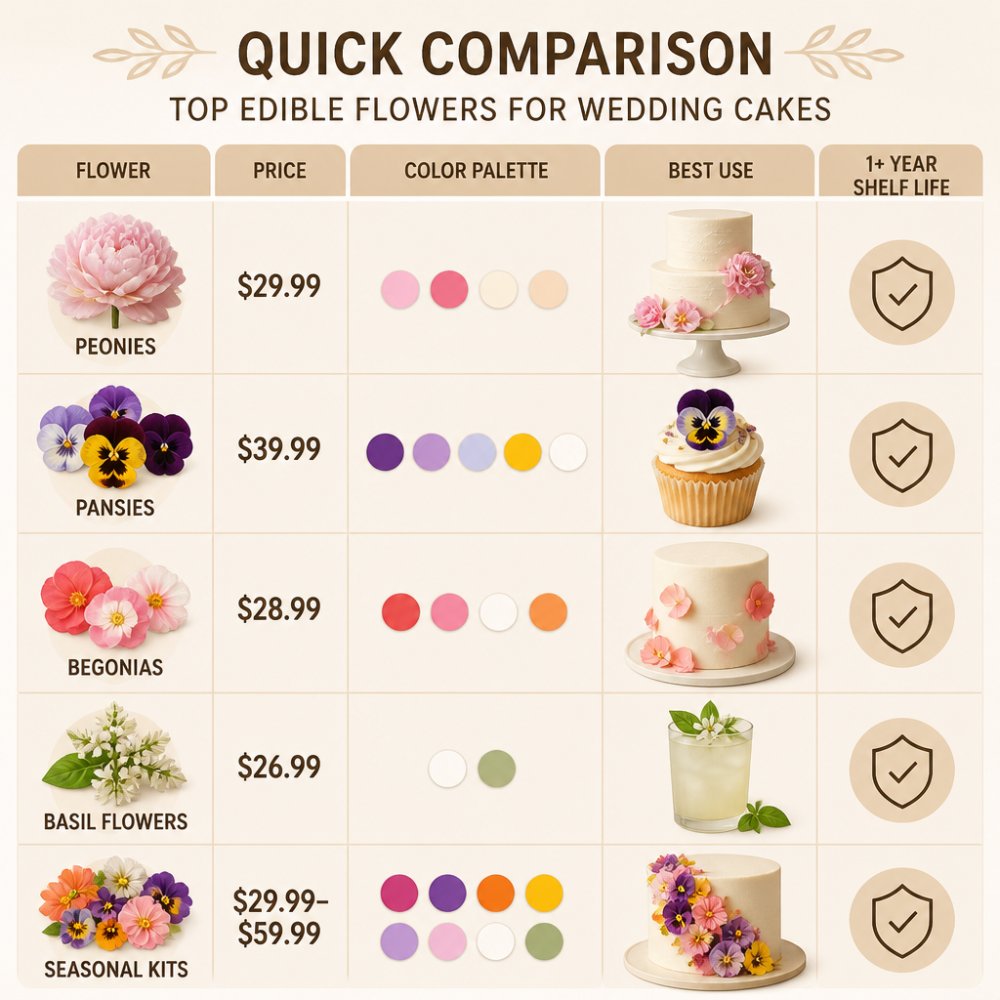
A quick scan of the options shows how much variety matters when you're matching blooms to a specific cake design and color palette. Every option below is food-grade, contains no preservatives or added sugar, and holds a shelf life of over one year in a cool, dry place.
| Flower | Price | Color Palette | Best Use | Shelf Life |
|---|---|---|---|---|
| Peonies | $29.99 | Ivory, blush, pink | Statement topper | 1+ year |
| Pansies | $39.99 | Vibrant mixed | Cupcakes, tiers | 1+ year |
| Begonias | $28.99 | Original vivid hues | Bold accents | 1+ year |
| Mums, Cosmos, Dahlias | $29.99 | Vivid mixed | Cookies, cocktails | 1+ year |
| Basil Flowers | $26.99 | Cream, white | Savory cakes | Up to 1 year |
| Seasonal Kits | $29.99-$59.99 | Curated by season | Full cake styling | 1+ year |
1. Freeze-Dried Edible Peonies
Peonies are the most requested wedding bloom for a reason: they read as romance without trying. The challenge has always been season and staying power. A fresh peony has a window of roughly a week, and it bruises if you look at it wrong.
Freeze-dried peonies remove both problems. Each package contains a mixture of sizes and colors, from minis to mediums, in soft ivory, blush, and pink, so you can build a gradient across a tiered cake instead of scattering identical blooms. The package holds a quantity of 5.

These are the pick for a statement topper or a cascade down one side of a cake. They also work on a charcuterie board if you're styling a grazing table alongside dessert.
2. Freeze-Dried Edible Pansies
Pansies earn their place through color range. Where peonies stay in the soft register, pansies bring saturated purples, yellows, and bi-color faces that can match almost any wedding palette.
Freeze-dried pansies maintain their original shape, flavor, and nutrients without added salts, sugars, dyes, or preservatives. That matters for couples who care about clean ingredient lists but still want a visual pop. The shape retention is what sets them apart: each bloom mirrors a freshly picked flower rather than a flattened pressed one.
Use pansies on shower cakes, cupcakes, and cookies where you want repetition and consistency. A single pansy centered on each cupcake reads as deliberate design, not garnish.
3. Freeze-Dried Edible Begonias
Begonias are the underused option on this list. They keep their original stunning color through the freeze-drying process, which makes them a strong choice when a couple's palette leans toward bold rather than pastel.
These blooms suit decorators who want something less expected than a rose or a pansy. They work as accent flowers tucked between larger blooms, or clustered on a single tier for a denser floral moment.
One note from experience: begonias are delicate in the hand. Place them with tweezers rather than fingers to avoid crushing the petals.
4. Freeze-Dried Edible Mums, Cosmos, and Dahlias
This trio brings the widest color range of any single product. Cosmos in particular adds a burst of vivid color to dishes and desserts, and the mix works across cookies, pastries, and cocktails as well as cake.
Bakers favor these for wedding cake decoration because the varied petal structures create texture that flat flowers can't. A tier styled with mums, cosmos, and dahlias together looks hand-arranged rather than purchased.

The practical advantage: one package covers multiple cake styles. If you're decorating several desserts for the same event, this mix stretches further than a single-variety order.
5. Freeze-Dried Edible Basil Flowers
Basil flowers are the quiet hero for savory-leaning weddings. The blossoms carry the savory essence of basil, which makes them a natural fit for herb-forward cakes, olive oil cakes, and dessert tables that lean less sweet.
The freeze-drying process extends shelf life in your cupboard, so you can keep them on hand for the occasional savory order rather than buying fresh and watching them turn. They hold peak fresh-picked taste for up to a year.
Pair basil flowers with honey cake, lemon-thyme layers, or a rosemary-infused buttercream. They also finish a cocktail garnish if you're styling a bar alongside the cake.
6. Seasonal Cake Decorating Kits
Seasonal kits are the fastest route to a fully styled cake. Instead of ordering five varieties separately, you get a curated blend built around a season or holiday.
The Spring kit includes roses, carnations, pansies, oregano flower, amaranth leaves, and ferns. The Fall kit brings roses, marigolds, carnations, geranium leaves, firesticks, oregano, and ferns. Summer leans into mini roses, lavender, peonies, basil blossoms, and flower confetti. The Christmas and Valentine's collection gathers red, pink, and white blooms including mini roses, carnations, peppercorns, watercress, geranium leaves, and firesticks.
If you want maximum variety without committing to a season, the mixed seasonal option delivers between 40 and 50 flowers in assorted colors, styles, and sizes, with a shelf life of over a year and no refrigeration required.
How to Clean Edible Flowers for Cakes
Cleaning edible flowers for cakes starts with the assumption that anything grown outdoors has been visited by insects and may carry residue. Even blooms sold as food-grade deserve a check before they touch frosting.
For freeze-dried flowers, the process is simpler than for fresh. Here's the sequence:
- Inspect each bloom under good light for grit, insects, or damaged petals. Discard anything with mold or rot.
- If the bloom needs a rinse, use cool water and a gentle shake. Never soak, which collapses delicate petals.
- Pat dry on a paper towel or lint-free cloth. Any surface moisture will soften the bloom and shorten its window on the cake.
- For fresh blooms, remove the stamen and pistil, which hold most of the pollen and the bitterest flavor.
- Separate petals from stems and any green base, which is often the most bitter part.
- Set cleaned blooms on a tray lined with paper towel and let them air-dry fully before placing.
For freeze-dried flowers, skip the water entirely unless you see visible grit. A soft brush removes dust without introducing moisture. This is one of the advantages of the freeze-dried format: less handling, less risk of damage.
Edible Flower Cake Decorating Ideas
Decorating with edible flowers rewards restraint. The most striking wedding cakes use fewer blooms placed with intent rather than a dense scatter.
Here are approaches that hold up across styles:
- Cascading single-variety: One bloom type flowing from the top tier down one side. Peonies or pansies work best because consistent shape reads as deliberate.
- Color-blocked tiers: Assign one flower color per tier to echo the wedding palette. Pansies and the mums-cosmos-dahlias mix give you the range to do this.
- Scattered confetti: Small petals and flower confetti pressed lightly into the top tier for a garden feel. Best with the Summer kit.
- Topper cluster: A tight grouping of large blooms at the crown, with minimal decoration elsewhere. Peonies are built for this.
- Savory accent: Basil flowers placed on a honey or olive oil cake for a less traditional, more modern finish.
A practical note on placement: press blooms into buttercream or fondant just before serving, not hours ahead, unless the cake will stay in a cool room. Freeze-dried flowers tolerate a longer window than fresh, but frosting softens any bloom over time.
For a fuller look without extra handling, a seasonal kit covers an entire cake in one order. Bulk orders are also available if you're decorating a multi-tier cake plus a dessert table.
How to Store Edible Flowers
Storing edible flowers correctly is what separates a bloom that looks fresh on the wedding day from one that fades in your pantry. The good news: freeze-dried flowers need almost nothing from you.
- Keep them in the original sealed package or an airtight container
- Store in a cool, dark, dry place, away from heat and direct light
- Skip the refrigerator entirely, which introduces moisture
- Keep away from strong odors, which freeze-dried blooms can absorb
- Check the seal before each event to confirm no moisture has crept in
Freeze-dried edible flowers hold a shelf life of over one year stored this way. That means you can order well ahead of a wedding date and keep varieties on hand for the whole season rather than reordering for each event.
Sugar Flowers vs. Fresh Edible Flowers
Sugar flowers and fresh edible flowers solve different problems, and the right choice depends on what you're optimizing for.
Sugar flowers (gumpaste and fondant work) are sculpted by hand, last indefinitely, and can match any color exactly. They are inedible in practice, taste like sugar paste, and cost far more in labor. A single hand-sculpted sugar peony can take an experienced decorator a significant amount of time to build.
Fresh edible flowers look and taste real, but they wilt within hours, require refrigeration, and are limited by season and availability. They also carry the sourcing risk that comes with any fresh agricultural product.
Freeze-dried edible flowers sit between the two. They keep the real appearance and flavor of the bloom, hold a shelf life of over a year without refrigeration, and arrive ready to place. For couples who want the real thing without the timing pressure, they're the practical middle path.
Sourcing Food-Grade Flowers Safely
Sourcing is where most floral cake plans go wrong. The bloom has to be grown for culinary use, not just grown organically or bought from a florist.
What to look for:
- Grown for culinary use: The grower intends the flower to be eaten, not just displayed.
- Pesticide-free: No sprays not approved for food crops, and no systemic pesticides that persist in the petal.
- No added dyes, sugars, or preservatives: Clean ingredient lists matter when the flower sits on a cake you're serving.
- Clear handling instructions: A reputable source tells you how to store and how long the product keeps.
Freshly Preserved offers the country's largest selection of premium, food-grade freeze-dried edible flowers, all 100% natural with no preservatives or added sugar. If you're a bakery or caterer buying for the season, bulk orders are available so you can stock the varieties you use most.
Allergy Considerations for Edible Flowers
Allergies are the most overlooked risk in floral cake design. A bloom can be perfectly food-grade and still trigger a reaction in a guest.
Pollen is the primary concern. It's why removing the stamen and pistil from fresh flowers matters, and it's one reason freeze-dried flowers are lower risk: the freeze-drying process preserves the bloom without leaving loose pollen to spread.
A few practical steps:
- Ask the couple about known allergies before finalizing the floral design, especially to pollen and to specific plant families.
- Keep blooms away from the slice line if a guest has a severe allergy, so cross-contamination stays minimal.
- Label the cake's floral elements at the dessert table so guests can make informed choices.
- When in doubt, place a small note with the cake listing the flower varieties used.
Freeze-dried flowers reduce but don't eliminate allergy risk. If a guest has a known plant allergy, treat any bloom on the cake as a potential trigger and plan around it.
Pairing Flowers with Cake Flavors
Pairing is where a wedding cake moves from pretty to memorable. The flower should echo or contrast the cake's flavor, not fight it.
- Peonies: Mild and slightly sweet. Pair with vanilla, almond, or a light rosewater buttercream.
- Pansies: Gentle, slightly grassy. Pair with citrus cakes, lemon curd fillings, or a fresh berry layer.
- Begonias: Mild with a hint of citrus. Pair with white chocolate or a light fruit cake.
- Mums, cosmos, dahlias: Varies by bloom, generally mild. Pair with a neutral sponge so the color carries the visual.
- Basil flowers: Savory and herbaceous. Pair with honey cake, olive oil cake, or a lemon-thyme layer.
A useful rule: match the flower's intensity to the cake's. A delicate pansy disappears on a heavy dark chocolate cake, and a bold basil flower overwhelms a plain vanilla tier.
Frequently Asked Questions
Are all flowers safe to put on wedding cakes?
No. Only food-grade, pesticide-free edible flowers are safe for cake decoration. Many florist blooms are treated with pesticides or chemicals that are not meant for consumption. Always verify that flowers are grown for culinary use and labeled food-grade. Avoid any flower that has been sprayed, and never use flowers from a garden center or florist without confirming they are edible. When in doubt, choose freeze-dried edible flowers from a trusted supplier that tests for safety.
How do you prepare edible flowers for a wedding cake?
For fresh edible flowers, gently rinse with cool water and pat dry on a paper towel. Remove stamens and pistils, which can be bitter. For freeze-dried edible flowers, no washing is needed because they are already cleaned and preserved. Handle them with tweezers to avoid crushing delicate petals. Apply them to the cake as close to serving as possible to prevent wilting. If using fresh flowers, refrigerate the decorated cake until 1-2 hours before the event.
Do edible flowers need to be refrigerated on a cake?
Fresh edible flowers on a cake should be refrigerated if the cake itself requires refrigeration, but add them as close to serving as possible because refrigeration can cause wilting and moisture damage. Freeze-dried edible flowers do not require refrigeration and can be stored at room temperature in a cool, dry place for over a year. Once placed on a cake, freeze-dried flowers hold their shape and color well for several hours, making them ideal for wedding displays.
Can you use freeze-dried flowers on wedding cakes?
Yes, freeze-dried edible flowers are an excellent choice for wedding cakes. They retain their original shape, color, and flavor without preservatives or added sugar. They have a shelf life of over one year and do not require refrigeration, which simplifies storage and planning. Freeze-dried flowers are less fragile than fresh blooms when handled properly and can be applied days in advance without wilting, making them a reliable option for tiered wedding cakes.
How long do edible flowers last on a cake?
Fresh edible flowers typically last 4-8 hours on a cake before wilting, depending on humidity and temperature. Freeze-dried edible flowers can hold their appearance for 24-48 hours on a decorated cake, though they are best applied within a day of serving. For longer displays, add flowers shortly before the event. Store unused freeze-dried flowers in a cool, dry place; they maintain quality for over a year without refrigeration.


