

Table of Contents
- Why Chefs and Bakers Buy Bulk Freeze Dried Edible Flowers
- Quick Comparison: Bulk Freeze Dried Edible Flower Options
- How to Choose Food Grade Edible Flowers for Cakes
- Product Collections and Varieties for Bulk Orders
- Wholesale and Bulk Ordering Options
- How to Store Freeze Dried Flowers for Maximum Shelf Life
- Culinary Applications and Pairing Guide
- Safety, Allergen Guidelines, and DIY Preservation Tips
- Conclusion
- Frequently Asked Questions
Last Updated: September 25, 2026
Why Chefs and Bakers Buy Bulk Freeze Dried Edible Flowers
When you buy bulk freeze dried edible flowers, you're buying more than decoration. You're buying shelf stability, consistent color, and a garnish that won't wilt two hours into service. This guide from Freshly Preserved covers what matters when you're sourcing them at volume.
The case for bulk is simple. Fresh flowers arrive fragile, die fast, and depend on season and shipping luck. Freeze-dried petals hold their shape and color, need no refrigeration, and keep for over a year in a cool, dry place. For a pastry team decorating dozens of cakes a week, that difference decides whether a garnish is a plan or a gamble.
What most guides miss is that not all "edible flowers" are truly food grade. Some are sold for crafts. Others are decorative varieties never intended for consumption. If you're serving customers, that distinction is the whole ballgame.
Below, we'll walk through how to buy bulk freeze dried edible flowers with confidence: what to compare, what certifications to demand, how to store them, and which varieties hold up on frosting. We'll also cover the safety and allergen questions most buyers only think about after the order ships.
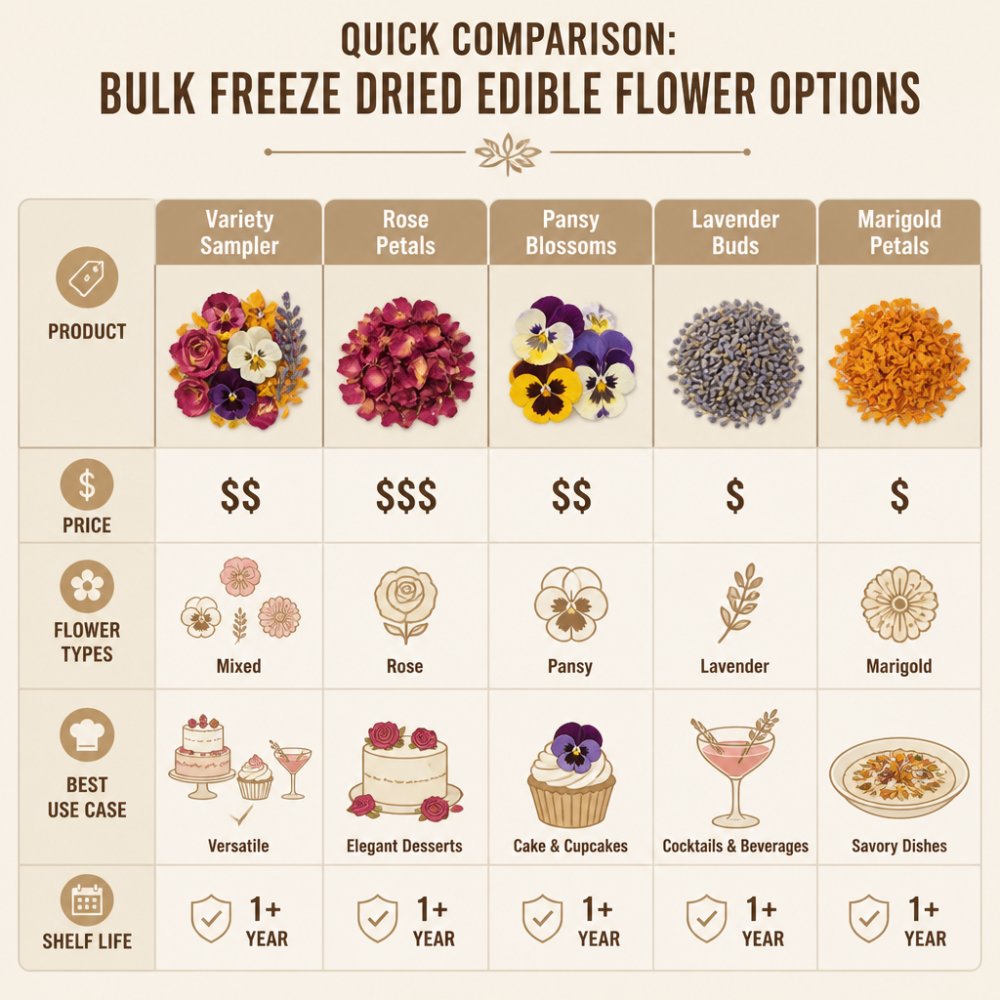
Quick Comparison: Bulk Freeze Dried Edible Flower Options
Here's a side-by-side look at the bulk-friendly options from Freshly Preserved. Use it to match variety and price to your use case before you commit to a larger order.
| Product | Price | Flower Types | Best Use Case |
|---|---|---|---|
| Variety Sampler Box | $17.00 | Random mixed flowers, herbs, leaves | Testing before bulk commitment |
| Freeze-Dried Flower Confetti | $23.99 | Mixed petals | Wedding cakes, plated desserts |
| Mini Roses & Mixed Petals | $29.99 | Mini roses, mixed petals | Romantic cakes, cocktails |
| Mini Carnations & Bachelor Buttons | $28.99 | Carnations, bachelor buttons | Charcuterie, pastries |
| Pansies & Orchids | $39.99 | Pansies, orchids | Signature cocktails, cakes |
| Mixed Seasonal Flowers | $59.99 | 40-50 seasonal blooms | Large events, varied displays |
How to Choose Food Grade Edible Flowers for Cakes
Food grade edible flowers for cakes are flowers grown and handled specifically for human consumption, free from pesticides and non-culinary treatments. If a flower is sold only for decoration, it does not qualify, no matter how good it looks.

Choosing well comes down to a few checks. Ask where the flowers were grown, whether they were cultivated for culinary use, and whether any dyes, sugars, or preservatives were added. A vendor who can answer those questions plainly is usually the one worth buying from.
Freshly Preserved sources only food-grade flowers grown domestically, then freeze-dries them without added sugar, salt, or preservatives. That matters for cakes because frosting is a moist surface. A clean, dry petal sits on top without bleeding color or turning limp.
Certifications and Quality Checks to Look For
The single most important quality check is whether the flowers are explicitly labeled food grade or culinary grade. Craft-grade flowers are not safe to serve.
Beyond the label, look for these signals:
- Grown without pesticides intended for ornamental use
- No added dyes, sugars, or preservatives
- Clear origin information (domestic farms with stated standards)
- A stated shelf life and storage method
- A vendor willing to answer allergen and sourcing questions directly
If you're serving the public, treat documentation as non-negotiable. Ask for confirmation the flowers are culinary grade before they touch a plate.
Product Collections and Varieties for Bulk Orders
Variety is where most bulk suppliers fall short. They stock roses and pansies, then run dry on anything less common. For wedding work and upscale plating, that limits your palette.
Freshly Preserved carries a broad range, from mini roses and carnation buds to mums, cosmos, dahlias, and bachelor buttons. The petals come in mixed and single-variety packs, so you can match a color story or build one from scratch.

Here's how the main collections break down by intent:
- Petal confetti for scattering across cakes and plated desserts
- Whole mini blooms for a single, deliberate focal garnish
- Mixed seasonal flowers (40-50 blooms per order) for events needing range
- Single-variety packs like pansies for consistent color across a run
The seasonal mix is the one to watch. It varies based on availability, so the exact blooms shift through the year. Check back seasonally if you're planning a specific palette.
Wholesale and Bulk Ordering Options
Wholesale and bulk ordering exist so you can buy at volume without committing to a rigid subscription. The goal is flexibility: order what you need for the month, not what a contract dictates.
Freshly Preserved offers wholesale and bulk orders directly, which suits bakeries that order in cycles rather than on a fixed schedule. You're not locked into recurring purchases, so a small home bakery can order a modest quantity for a single wedding and a commercial kitchen can order larger.
How to Size a Bulk Order Without Overbuying
The most common mistake is ordering for your busiest week instead of your average month. A workable formula:
- Count how many garnished items you plate in a typical week.
- Multiply by the number of petals or blooms per item (usually 1 whole bloom or a pinch of confetti).
- Multiply by 4.3 to get a monthly figure.
- Add a 15-20% buffer for breakage, since freeze-dried petals are brittle.
For a small operation decorating 20-30 cakes a month, that math usually lands well inside a single bulk order, and the over-one-year shelf life is what makes the surplus safe to hold.
Ordering Logistics That Actually Matter
- Lead times: Confirm turnaround before peak wedding season (late spring through early fall), when demand spikes and stock on seasonal mixes moves fastest.
- Seasonal availability: Mixed seasonal collections shift with what's available, so lock a specific palette earlier than you would a single-variety pack.
- Color consistency: If you need the same shade across a multi-week run, order the full quantity at once rather than reordering mid-project; natural variation between batches is normal.
- Storage before use: Plan where the surplus will live before it arrives, a cool, dry, dark cabinet, not the walk-in.
- Reorder triggers: Set a par level (for example, reorder when you're down to two weeks of supply) so a large event never catches you short.
Matching Order Size to Operation Type
| Operation | Typical Order Pattern | What to Watch |
|---|---|---|
| Home baker / cottage food | Occasional single-event orders | Buy sampler first; storage space is the constraint |
| Small retail bakery | Monthly cycle orders | Match to average week, not holiday peak |
| Commercial kitchen | Larger recurring bulk orders | Confirm lead times and batch color consistency |
| Caterer / event florist | Project-based bulk orders | Order full quantity per event to avoid batch mismatch |
Questions to Ask Before You Commit to Volume
- Is there a minimum order quantity, and does it change by variety?
- Can you mix varieties within one bulk order, or is each sold separately?
- What's the stated shelf life and recommended storage method?
- Will the same variety look consistent from one batch to the next?
- What's the return or replacement policy if a shipment arrives crushed?
A vendor who answers these plainly is the one worth buying from at volume. The shelf life is what makes bulk math work, buy once, store properly, and the order stays usable for over a year.

How to Store Freeze Dried Flowers for Maximum Shelf Life
Learning how to store freeze dried flowers is straightforward: keep them cool, dark, and dry, and they hold for over a year. Moisture and light are the two things that shorten their life.
Here's the storage routine that protects color and texture:
Variety Sampler Box →
- Keep the package sealed until you're ready to use it
- Store in a cool, dark, dry place, away from the stove or dishwasher
- Reseal tightly after each use to keep moisture out
- Avoid the refrigerator; condensation is the enemy
- Handle with dry hands or tweezers to preserve shape
Freeze-dried flowers are brittle by nature, and that's the trade-off for their long shelf life. The trick to keeping them intact on a finished cake is placement, not force. Set them gently on frosting with a light touch rather than pressing them in.
Culinary Applications and Pairing Guide
Freeze-dried edible flowers work across cakes, cocktails, charcuterie, and savory plates. The pairing question is really about color and flavor balance, not strict rules.
For cakes and pastries, scatter petal confetti for texture or place a single whole bloom as a focal point. Mini roses and carnation buds read as romantic and suit wedding and anniversary work. Pansies bring bright, saturated color to cupcakes and cookies.
For cocktails, float a bloom or dust petals over the surface. Orchids and pansies hold their shape well on a drink. For charcuterie and main dishes, carnations, bachelor buttons, and mixed petals add a savory-appropriate accent.
A simple pairing framework:
- Wedding cakes: mini roses, carnation buds, petal confetti
- Bright, playful desserts: pansies, cosmos, mums
- Signature cocktails: orchids, pansies, single blooms
- Charcuterie and savory: bachelor buttons, mixed petals
Texture retention is the quiet advantage here. Freeze-drying preserves the flower's original shape, so a bloom looks picked-this-morning even months later.
Safety, Allergen Guidelines, and DIY Preservation Tips
Safety comes first when flowers meet food. Only serve flowers you know are culinary grade, and treat every new variety as a potential allergen until you've confirmed otherwise. Most competing guides skip this entirely, here's the specific guidance they leave out.
Allergen Risks Specific to Edible Flowers
Flowers are plants, and plant allergies are real. The reactions that matter most fall into a few categories:
- Pollen allergies: People with seasonal hay fever can react to pollen still present on or in floral material. Freeze-drying preserves structure, so pollen-bearing parts remain intact.
- Botanical family cross-reactivity: Someone allergic to a plant in the same family as a garnish flower may react. The daisy family (Asteraceae), which includes chrysanthemums, dahlias, cosmos, and bachelor buttons, is a common one to flag. The rose family (Rosaceae) is another.
- Oral allergy syndrome: Some people with birch or ragweed pollen allergies experience tingling or itching after eating certain raw plant material. This is worth knowing if you serve floral garnishes to the public.
A short safety checklist:
- Confirm food-grade sourcing before serving.
- Note floral garnishes on menus or labels so guests can self-select out.
- Ask about plant allergies when relevant, especially for set menus and events.
- Keep flowers away from raw meat and cross-contamination zones.
- Store and handle with dry hands or clean tweezers to avoid transferring moisture or contaminants.
Why Commercial Freeze-Drying Beats DIY Preservation
The honest answer is that home methods rarely match commercial freeze-drying, and the reason is mechanical, not marketing.
- Air-drying removes moisture slowly at room temperature. The slow process lets enzymes and oxygen break down pigments, so colors fade toward brown and petals curl and shrink.
- Oven-drying applies heat, which cooks the flower. Heat damages the cell structure, so petals turn brittle, dull, and lose their original shape.
- Commercial freeze-drying freezes the flower, then pulls moisture out under vacuum through sublimation, ice turns directly to vapor without passing through liquid. Because the cell structure is frozen in place, the flower keeps its original shape, color, and volume.
That structural preservation is why a freeze-dried bloom looks picked-this-morning months later, while an air-dried one looks like dried potpourri within weeks. If you want vibrant, intact blooms, buying professionally freeze-dried flowers is the practical path.
Rehydrating and Handling Tips
Freeze-dried flowers are meant to be used dry, they're a garnish, not an ingredient to soak. If a petal softens from contact with frosting or a cocktail, that's expected and fine; it will simply lose some crispness. For maximum shelf life, keep them sealed and dry until the moment of plating.
Treat every floral garnish as a potential allergen, confirm food-grade status before serving, and understand that commercial freeze-drying, not home air- or oven-drying, is what preserves color and shape.
Conclusion
Sourcing floral garnishes at volume comes down to three things: confirmed food-grade quality, storage that protects color, and a supplier with real variety. Get those right and a bulk order becomes a reliable part of your kitchen, not a risk.
Freshly Preserved is built for exactly this. We offer the largest selection of food-grade, freeze-dried edible flowers, all 100% natural, made domestically, with no preservatives and no added sugar. Every order keeps for over a year in a cool, dry place, so you can buy bulk freeze dried edible flowers without worrying about waste.
Get started with Freshly Preserved and give your cakes, cocktails, and plated dishes a garnish that looks as good on day 300 as it did on day one.
Frequently Asked Questions
Are freeze dried edible flowers safe for cake decorating?
Yes, as long as you buy from a supplier that sells food-grade, culinary-grade flowers. Freshly Preserved flowers are grown in the United States, freeze-dried in a licensed commercial facility, and contain no preservatives or added sugar. Always confirm the product is labeled food-grade before placing it on a cake you will serve to customers. Avoid flowers sold only for craft or decorative use.
How long do bulk freeze dried edible flowers last once opened?
Freshly Preserved flowers have a shelf life of over 1 year and do not require refrigeration. Once you open a container, reseal it tightly and place it in a cool, dark, dry spot. Moisture is the main threat, so keep the package sealed between uses. If you buy bulk freeze dried edible flowers, transfer small working amounts to an airtight container and leave the rest sealed.
How do you store bulk freeze dried edible flowers to maintain quality?
Keep them in a cool, dark, dry place away from heat, sunlight, and steam. Do not refrigerate or freeze the flowers. Use an airtight container or the original vacuum-sealed bag, and squeeze out excess air before resealing. For bulk orders, portion out what you need for the week and keep the main supply sealed. Proper storage preserves vibrant colors and texture retention for over a year.
What is the difference between air-dried and freeze-dried edible flowers?
Air-dried flowers lose moisture slowly through evaporation, which often dulls color and makes petals brittle or leathery. Freeze-dried flowers go through a low-temperature vacuum process that removes moisture while keeping the original shape, vibrant colors, and flavor. For cake decoration and cocktail garnishes where appearance matters, freeze-dried flowers hold up better and look closer to fresh blooms.
Can you eat freeze dried flowers, and are all flowers sold as edible safe?
Freeze-dried edible flowers from a food-grade supplier are safe to eat. However, not every flower sold as edible is safe. Some flowers are toxic, and flowers grown for ornamental use may carry pesticides. Buy only from suppliers who confirm culinary grade, pesticide-free growing, and food-grade handling. Freshly Preserved sources flowers from U.S. farms with high standards and freeze-dries them in a licensed facility.


