

Table of Contents
- Why Buying Wholesale Edible Flowers Makes Sense for Bakeries
- Types of Edible Flowers for Baking and Pastry Design
- Pressed vs. Freeze-Dried Edible Flowers: Which Lasts Longer?
- Edible Flower Safety Standards for Bakers: What to Verify
- How to Source Wholesale Edible Flowers: Step-by-Step
- Wholesale Pricing and Bulk Ordering Breakdown
- How to Store Freeze-Dried Edible Flowers for Maximum Shelf-Life
- Seasonal Availability of Blooms: Planning Your Orders
- Logistics of Wholesale Delivery for Small-Batch Bakeries
- Decorating Cakes with Edible Flowers: Techniques for Professionals
- Cost-Benefit Analysis: Fresh vs. Freeze-Dried Edible Flowers
- Common Mistakes When Buying Wholesale Edible Flowers
- Conclusion: Choosing the Right Wholesale Partner
- Frequently Asked Questions
Last Updated: September 21, 2026
Why Buying Wholesale Edible Flowers Makes Sense for Bakeries
Buying wholesale edible flowers is the practice of purchasing food-grade blooms in bulk quantities at a lower per-unit cost than retail packs, giving bakeries a reliable supply of decorative garnishes for cakes, cookies, and plated desserts. For professional bakers, the appeal is simple: consistent quality, better margins, and the ability to plan menus around seasonal availability instead of scrambling for whatever a grocery store happens to stock.
This guide from Freshly Preserved covers how professional bakers and pastry chefs source, verify, store, and decorate with wholesale edible flowers.
The economics matter more than most bakers expect. A single retail clamshell of fresh pansies might garnish a handful of cupcakes before wilting, while a bulk order of freeze-dried blooms can sit in your pantry for months and still look vibrant on a finished cake. That difference in usable yield is where wholesale buying pays for itself. Below, we'll walk through the full sourcing process, the safety checks that protect your business, and the storage habits that keep colors bright long after delivery.
Types of Edible Flowers for Baking and Pastry Design
Not every flower belongs on a cake. Edible flowers for baking fall into two broad groups: familiar blooms with a mild, sweet, or peppery flavor, and specialty varieties that bring unusual color and texture to pastry design. Knowing which is which helps you match a flower to the dessert rather than the other way around.
Popular Blooms: Pansies, Violas, Roses, and Lavender
Pansies and violas are the workhorses of cake decoration. Their flat, open faces sit neatly on buttercream, and their purple, yellow, and white tones survive freeze-drying well. Roses bring a more formal, romantic look to wedding cakes and tiered desserts, while lavender adds a subtle floral note that pairs naturally with honey, lemon, and vanilla flavors. These four are the ones most bakers reach for first because they're widely available, easy to place, and recognizable to customers.
Specialty Varieties: Nasturtiums, Marigolds, and Borage
Nasturtiums carry a peppery bite that suits savory-leaning desserts and charcuterie boards. Marigolds deliver bold orange and gold petals that hold their shape on cookies and cupcakes. Borage, with its small star-shaped blue flowers, is the one that makes guests ask questions, which is exactly the point when you're building a reputation for distinctive pastry design. These specialty blooms are harder to find fresh, which is one more reason bulk buying from a dedicated supplier beats a last-minute trip to a farmers market.
Pressed vs. Freeze-Dried Edible Flowers: Which Lasts Longer?
Freeze-dried edible flowers hold their shape, color, and structure for over a year when stored properly. Freeze-dried flowers keep their three-dimensional form, so a rose petal still looks like a rose petal rather than a pressed silhouette. That structure matters when you're placing blooms on frosting, where a flat pressed flower can disappear into the surface. Freeze-dried blooms also rehydrate slightly when they contact moisture, which helps them cling to buttercream instead of sliding off.
| Attribute | Pressed Flowers | Freeze-Dried Flowers |
|---|---|---|
| Shape retention | Flat, two-dimensional | Full, three-dimensional |
| Best use | Cookies, macarons, glazed surfaces | Cakes, cupcakes, plated desserts |
| Handling | Very fragile, tears easily | Holds form, easier to place |
| Storage life | Shorter once opened | Over one year, sealed and dry |
| Color vibrancy | Good but muted | Bright, true to fresh color |
Edible Flower Safety Standards for Bakers: What to Verify
Edible flower safety standards for bakers come down to one question: can you prove the flowers were grown and handled as food, not as ornament? Any flower sold for decoration rather than consumption may carry pesticides, fungicides, or processing residues that have no place on a dessert you serve to customers. Most competitors stop at "ask your supplier." The section below goes further and gives you an actual verification checklist you can run before your first order.
Pesticide-Free and Organic Certification Checks
Ask your supplier directly whether their flowers are grown pesticide-free and whether they hold organic certification. A reputable wholesale partner will answer without hesitation and can point to documentation. If a supplier is vague about growing practices, treat that as a red flag. Flowers grown for the floral trade are often sprayed with compounds approved for ornamental use only, and those compounds are not cleared for food contact.
When a supplier claims organic status, verify it rather than take their word for it. In the United States, organic certification is administered through the USDA National Organic Program, and certified operations receive a certificate that names the certifying agent and the scope of what was certified. A few concrete checks catch most problems:
- Ask for the certificate, not a logo. A logo on a product page proves nothing. Request the current certificate and confirm the operation name and products listed match what you're buying.
- Confirm the certifying agent. Certificates name the USDA-accredited certifier that issued them. If a supplier can't name theirs, the claim is unverified.
- Check the scope. A certificate that covers, say, fresh herbs does not automatically cover every bloom the supplier sells. Match the scope to your order.
- Ask how the claim is maintained. Organic status depends on ongoing inspections, not a one-time approval. A supplier who can describe their last audit is a supplier who is actually in the program.
If a supplier is not certified organic but claims "pesticide-free," ask what that means in practice: which inputs are used, how pests are managed, and whether any synthetic compounds are applied at any stage. "Pesticide-free" is not a regulated term the way "organic" is, so the burden is on you to pin down the specifics.
Food-Grade and Culinary-Grade Documentation
Food-grade and culinary-grade mean the flowers were produced under conditions intended for human consumption, with attention to clean handling, pest control, and packaging. Request documentation confirming the flowers are food-grade, and keep it on file. For bakers serving the public, that paper trail is your defense if a customer ever raises a question about what's on their plate.
A practical documentation file for each supplier should include:
- A written statement that the flowers are grown and handled as a food product
- The supplier's food safety plan or a summary of their handling procedures
- Organic certificate, if applicable, with certifying agent and scope
- Product specifications covering variety, form (freeze-dried), and packaging
- Lot or batch identification so a specific shipment can be traced if a question arises
The FDA guidance on edible flowers and food safety is a useful starting point for understanding how regulators treat flowers intended for consumption. Note that "food-grade" and "culinary-grade" are not themselves government certifications, they are industry descriptions, which is exactly why the underlying documentation matters more than the label.
A Pre-Order Verification Checklist
Run this before you place a bulk order, and re-run it annually or whenever you switch suppliers:
- Confirm the supplier's business is dedicated to edible flowers, not general florals.
- Request the food-grade statement and food safety plan summary in writing.
- Request the organic certificate if organic is claimed, and verify the certifying agent and scope.
- Ask which specific blooms are covered by which documentation.
- Request a sample and inspect for residue, off odors, or discoloration.
- File everything with the date received so your records stay current.
How to Source Wholesale Edible Flowers: Step-by-Step
Sourcing wholesale edible flowers is a five-step process: define your needs, verify safety documentation, request samples, compare pricing at your expected volume, and set up a repeatable reorder schedule. Work through it once and future orders take minutes.
- Audit your menu and volume. List every dessert that uses floral garnish and estimate how many blooms each one needs per week. This number drives everything else.
- Shortlist suppliers who specialize in food-grade flowers. General florists and grocery wholesalers rarely meet the standard. Look for suppliers whose entire business is edible flowers.
- Request safety and certification documentation. Ask for proof of food-grade handling and, where relevant, organic certification before you commit to anything.
- Order a sample box first. A small sampler lets you test color, structure, and how the blooms behave on real frosting before you buy in bulk.
- Compare pricing at your actual volume. Unit cost drops as order size grows, so price your typical monthly need, not a one-off small order.
- Lock in a reorder cadence. Set a standing schedule around your busiest seasons so you're never decorating a wedding cake with whatever's left in the jar.
For bakers who want to test the waters without a large commitment, a Variety Sampler Box is a low-risk way to see how different blooms perform on your own cakes before scaling up.

Wholesale Pricing and Bulk Ordering Breakdown
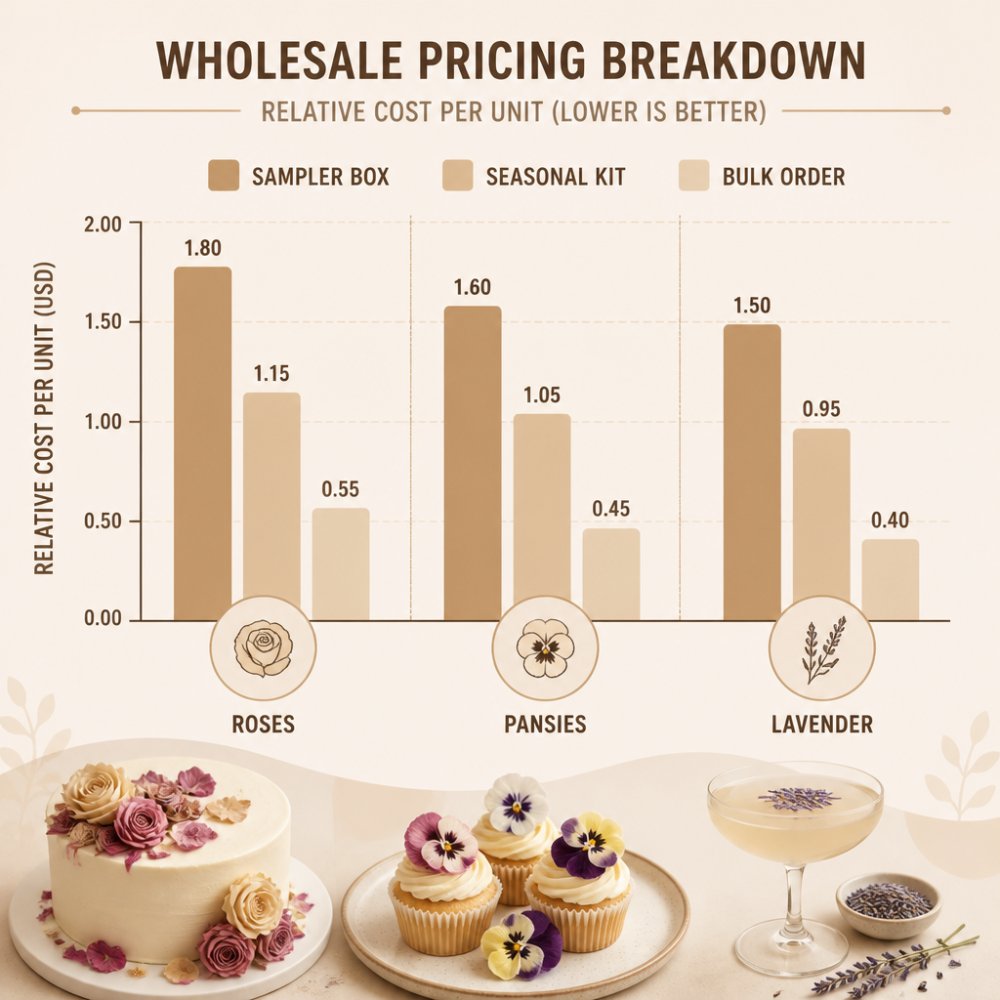
Wholesale pricing for edible flowers is driven by three factors: the flower variety, the order size, and how the blooms are preserved. Freeze-dried and pressed flowers cost more per unit than fresh at the point of sale, but they waste far less, which usually flips the math in their favor for bakeries that decorate steadily.
How Wholesale Pricing Is Actually Structured
Most edible flower suppliers price on a tiered schedule rather than a single flat rate. The tiers typically look like this:
Variety Sampler Box →
- Sampler or trial quantities carry the highest cost per unit because you're paying for variety, individual packaging, and the labor of assembling a mixed box.
- Mid-size kits bring the unit cost down while keeping a useful range of colors and varieties.
- Bulk or case quantities deliver the lowest cost per unit, but only make sense once you know which varieties you actually use and can commit to a repeatable order.
The practical implication is that your per-unit cost is a function of your ordering discipline, not just the supplier's list.
Minimum Order Quantities and What They Mean for You
Minimum order quantities (MOQs) are the single biggest friction point for small-batch bakeries, and most competitors gloss over them. An MOQ is the smallest quantity a supplier will sell at wholesale pricing. It exists because packing, labeling, and shipping small orders costs the supplier nearly as much as large ones.
- Is the MOQ per variety, per order, or per shipment?
- Can MOQs be met by mixing varieties within a single order?
- Does the MOQ change if you set up a recurring order?
- Are there smaller "starter" quantities available at a higher unit cost?
Shipping, Handling, and Delivery Timing
Shelf-stable flowers ship dry, store at room temperature, and don't consume cooler space you need for buttercream and cream fillings.
| Order Type | Typical Use Case | Relative Cost Per Unit | Best For |
|---|---|---|---|
| Sampler box | Testing varieties | Highest | New bakers, trial runs |
| Seasonal decorating kit | Themed menus | Mid-range | Regular decorators |
| Bulk order | High-volume production | Lowest | Busy bakeries, caterers |
How to Store Freeze-Dried Edible Flowers for Maximum Shelf-Life
To store freeze-dried edible flowers for maximum shelf-life, keep them sealed in an airtight container in a cool, dry place away from light and moisture. Freeze-dried blooms have a shelf life of over one year and do not require refrigeration, which makes them far easier to manage than fresh flowers.
- Keep the original sealed packaging until you're ready to use the flowers
- Transfer opened flowers to an airtight container with a tight-fitting lid
- Store away from steam, sinks, and dishwashers
- Use a desiccant packet if your kitchen runs humid
- Reseal immediately after each use
Seasonal Availability of Blooms: Planning Your Orders
Seasonal availability shapes what you can offer and when. Pansies and violas peak in cooler months, roses and lavender run through summer, and marigolds and nasturtiums thrive in warmer weather. Planning your dessert menus around these windows keeps your costs predictable and your garnishes at their best.
Logistics of Wholesale Delivery for Small-Batch Bakeries
Small-batch bakeries face a logistics problem that large operations don't: they need variety without warehousing a year's supply. The fix is to treat shelf-stable flowers as inventory you can actually hold, rather than perishable goods that force constant reordering.
Decorating Cakes with Edible Flowers: Techniques for Professionals
Decorating cakes with edible flowers techniques come down to placement, contrast, and restraint. A few well-placed blooms read as elegant; a dense scatter reads as busy. The goal is to guide the eye, not cover the surface.
Cost-Benefit Analysis: Fresh vs. Freeze-Dried Edible Flowers
Run the comparison on usable yield, not purchase price. Freeze-dried flowers keep for over a year with no refrigeration, so almost nothing is lost to spoilage. For a bakery decorating steadily, that difference usually outweighs the higher upfront cost.
Common Mistakes When Buying Wholesale Edible Flowers
The mistakes that cost bakers the most are predictable, and each one is avoidable.
- Buying decorative flowers by mistake. Flowers sold for arrangements aren't grown for consumption. Always confirm food-grade status.
- Skipping the sample order. Bulk pricing is tempting, but buying a large quantity of a variety you've never tested on frosting is a gamble.
- Ignoring storage conditions. Even shelf-stable flowers degrade if left open in a humid kitchen. Seal them properly.
- Over-ordering specialty blooms. Unusual varieties are fun but easy to overbuy. Match quantities to how often you'll actually use them.
- Forgetting the documentation. Keep certification and food-grade records on file. It protects you if a question ever arises.
Conclusion: Choosing the Right Wholesale Partner
The hardest part of buying wholesale edible flowers isn't finding a supplier, it's finding one that treats safety, consistency, and shelf-life as seriously as you treat your cakes. A partner who documents food-grade handling, stocks real variety, and ships shelf-stable blooms removes the guesswork from your garnish program.
Frequently Asked Questions
What should professional bakers look for when buying wholesale edible flowers?
Look for food-grade certification, pesticide-free verification, and clear labeling that the flowers are culinary-grade. Check for organic certification if possible, and confirm the supplier provides documentation of food safety standards. Also assess shelf-life claims, moisture control, and the texture and longevity of freeze-dried flowers. Finally, review minimum order quantities and whether bulk pricing aligns with your production volume.
Are freeze-dried edible flowers better for cake decorating than fresh?
Freeze-dried edible flowers offer a shelf life of over one year and do not require refrigeration, making them ideal for professional bakeries. They retain color and shape better than fresh flowers, which wilt quickly. Fresh flowers can introduce moisture and may not be food-safe unless grown for consumption. Freeze-dried options are also easier to store and transport, reducing waste and ensuring consistent availability for cake decoration and cookie garnish.
How do you store wholesale edible flowers to maintain quality?
Store freeze-dried edible flowers in a cool, dry place away from direct sunlight and moisture. Keep them in their original airtight containers or transfer to sealed glass jars. Avoid refrigeration, as condensation can cause rehydration and spoil texture. Properly stored, they maintain color and structure for over a year. For bulk orders, divide into smaller portions to minimize exposure each time you open the container.
Are all flowers sold as edible safe for consumption?
No. Only flowers grown specifically for culinary use and certified food-grade are safe. Many flowers sold for ornamental purposes are treated with pesticides or may be toxic. Always verify that the supplier provides pesticide-free and food-grade documentation. Avoid flowers from gardens or florists unless explicitly labeled edible. For professional baking, purchase from reputable wholesale sources that follow food safety standards and offer organic certification when possible.
What are the benefits of using food-grade flowers in professional baking?
Food-grade flowers enhance floral aesthetics and add natural color to cakes, cookies, and pastries without artificial dyes. They are safe for consumption and meet food safety standards. Freeze-dried options like pansies, violas, and roses retain their shape and vibrant colors, making them ideal for cake decoration and cookie garnish. They also offer a long shelf-life and require no refrigeration, simplifying inventory management for bakeries.
How can I verify pesticide-free and organic certification when buying wholesale?
Request certificates from your supplier confirming pesticide-free status and organic certification if applicable. Look for third-party testing documentation and ask about their growing practices. Reputable wholesale edible flower suppliers will provide transparency about their supply chain. You can also check for USDA organic certification labels. Always review food safety standards compliance to ensure the flowers are safe for consumption on desserts.
What is the typical minimum order quantity for wholesale edible flowers?
Minimum order quantities vary by supplier. Some offer small quantities suitable for home bakers, while others cater to high-volume commercial kitchens. For small-batch bakeries, look for suppliers with flexible MOQs, such as 1oz sampler boxes or 4oz packs. Bulk ordering often reduces unit cost, but ensure you can store the product properly to maintain shelf-life. Always confirm whether regular purchase commitments are required.
How do freeze-dried edible flowers compare in cost to fresh flowers for cake decoration?
Freeze-dried edible flowers may have a higher upfront cost per unit than fresh, but they offer significant savings over time due to their long shelf-life and minimal waste. Fresh flowers are perishable and require cold chain shipping, which adds to cost and logistics. Freeze-dried flowers eliminate spoilage, reduce reordering frequency, and provide consistent quality year-round, making them cost-effective for professional bakeries.


